
Wildlife crime
Wildlife crime
Despite being protected by law since 1835, British wildlife is still widely persecuted throughout Britain today.
Wildlife crime is a very broad term. It needs to be, as it covers a whole host of legislation and criminal offences committed against various species of wildlife.
In the UK, many wild animals are protected by law, making it illegal to harm or kill them, sell or trade them, or interfere with them, for example, by stealing eggs or destroying their habitat.
Despite the legislation in place, wildlife crime continues to be rife. From barbaric ‘blood sports’ like badger baiting and hare coursing to deliberate or reckless damage to their environment. From the illegal taking of animals from the wild for the wildlife trade to further cruelty on home soil, such as fox digging, our wildlife continues to be at risk. We’re here to fight to stop this as long as it continues.
It is estimated that the illegal wildlife trade is worth up to £17 billion a year and is a significant serious and organised crime generator; the fourth largest after drugs, firearms, and human trafficking. Furthermore, there are tangible links between specific wildlife crime types and organised criminality, such as hare coursing.
Explore this section
The story so far…
How far we've come…
-
Working closely with the police, our investigators have played a key role in holding badger baiters, hare coursers, and other animal abusers accountable across the UK. Their expertise has earned recognition and praise from judges, barristers, and senior police leaders alike.
-
Thanks to the generosity of our supporters, we have helped fund essential online training for police officers and staff. This training equips them to better tackle national wildlife crime priorities, identify wildlife crimes, and accurately record incidents involving animals and wildlife
-
We partnered with the police and the RSPCA to create Operation RECALL, the national initiative tackling livestock worrying and attacks. Focused on reducing crime and educating offenders, it is used by police forces across the UK under the National Police Chiefs' Council’s Rural Crime Strategy.

In August 2023, we launched our Force Control Room wildlife crime animated training package for police staff tasked with receiving wildlife crime reports from members of the public.

At the end of 2025, Operation Major was launched at the UK Wildlife Enforcers Conference to highlight horrific injuries caused to dogs used in the commission of wildlife crime.
Our wildlife crime investigators are regularly submitting quality, comprehensive information to police forces across England and Wales.
With your support, we have contributed towards the National Wildlife Crime Unit’s online Badger persecution training video. This video, a crucial resource for law enforcement, equips officers with the knowledge and skills to combat badger persecution, a significant threat to our wildlife.
We are proud to partner with the National Rural Crime Network (NRCN). Our role is to advocate for protecting wildlife and domestic pets in rural areas, enhancing the network’s mission to improve community safety.
Next steps…
-
Our Make Wildlife Count campaign is urging the Home Office to properly record wildlife crime figures.
-
Our Target Crime Not Wildlife campaign is urging the government to legislate for robust selling and possession of catapults and weapons of wildlife persecution.
-
Through our advocacy and campaigning, we raise awareness and promote the prevention of wildlife crime affecting multiple species. Our Target Crime, Not Wildlife, and OP RECALL campaigns highlight the need for stronger protection through varied approaches.
-
Continue getting young people passionate about protecting wildlife.
The latest wildlife crime statistics
The 2026 Wildlife Crime Report from the Wildlife and Countryside Link was published in October 2026. This report details wildlife crime in England and Wales for 2025. Naturewatch Foundation is part of this coalition and plays a contributing role in producing the annual report.
Key findings - 2024-2025
Wildlife crime continues to be reported at worrying levels, much the same as in recent years.
- Less than 2% of wildlife crime cases in 2025 ended in a conviction — an incredibly low figure considering the scale of the problem.
- Marine Mammals – Grey seals. Disturbance is a significant threat to grey seals. 2025 saw a substantial increase in both disturbance incidents and number of seals disturbed across the southwest of England.
Wildlife crime totals (2017–2025)
- A staggering 14,523 incidents were reported over this period.
- Only 361 of those resulted in convictions.
- That’s a 2.4% conviction rate — a reminder of how much still slips through the cracks.
Other key trends (2017–2025)
- In 2025, there were 25 prosecutions for offences under the Hunting Act and 18 convictions. The average fine for those convicted was £460. (Source: Ministry of Justice Criminal Justice Statistics Quarterly: December 2025.)
- As seen in our Target Crime not Wildlife campaign, the growing use of catapults and slingshots to injure or kill wildlife or harm companion animals is a serious concern, with links to social media and younger offenders.
Catapult crime case studies
- Newbury (November 2025): RSPCA responded to a call that a hedgehog had died from injuries caused by a catapult attack.
- Maidstone (June 2025): RSPCA responded to a Canada goose found seriously injured from a catapult attack and later had to be euthanised.
Making Wildlife Count
Human-inflicted harm for entertainment or profit is senseless. The Government should deliver tougher wildlife-crime penalties, but deterrence also requires greater public and police awareness, stronger support for the National Wildlife Crime Unit, and key offences made notifiable to the Home Office. Better data would help target enforcement, given wildlife crime’s links to violent and organised crime. We continue our Make Wildlife Count campaign, and you too can play a part here.
These results show that wildlife crime is often part of wider criminal behaviour, and tackling it will help protect animals and protect people.
What is the law surrounding wildlife crime?
Wildlife and animal welfare legislation can often be confusing and sometimes restrictive in its application.
The Wildlife and Countryside Act 1981 is the primary legislation covering wildlife protection in England, Scotland and Wales, barring certain exceptions. Northern Ireland, however, has a separate legislation titled ‘the Wildlife Order’.
When investigating wildlife crime, other pieces of legislation can be used, including:
- Animal Welfare Act 2006
- Hunting Act 2004
- Deer Act 1991
- Protection of Badgers Act 1992
- Night Poaching Act 1828,
- Wild Mammals (Protection) Act 1996
and even the Theft Act 1968.
There is a lot of legislation, and those listed above are generally those used by investigators as their “go-to”. However, what isn’t listed are the species-specific laws; the list is vast and varied. So, when it comes to investigations, the legislation available can be complex and confusing!
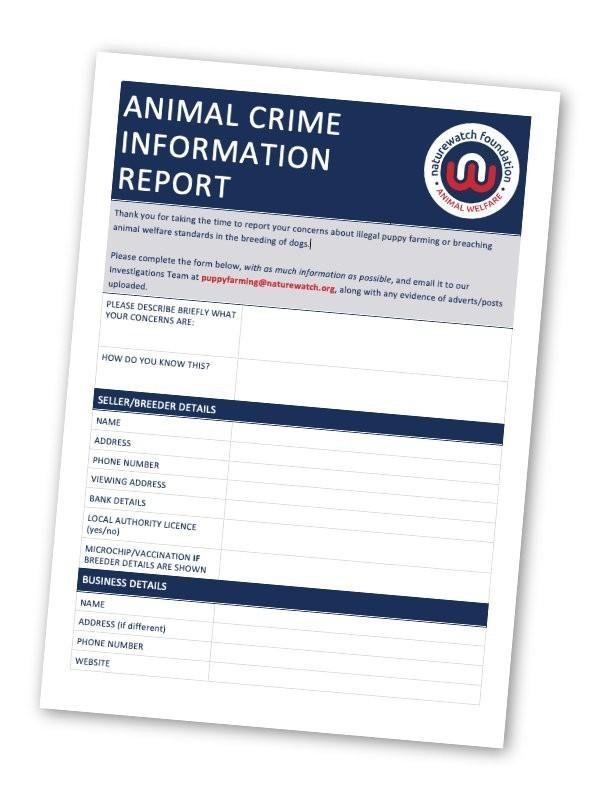
Reporting a crime
If you suspect individuals or groups are involved in the hunting of wildlife using dogs, such as badger baiting, hare coursing, deer hunting etc. please don’t keep it to yourself.
We work hard to investigate wildlife crime, but we can’t do it alone – we need your help. It’s easy to report it safely and anonymously.


