In 2017 alone, over 1.8 million additional animals were bred for science in Britain and either died or were killed without being used in experiments. They haven't been included in official government figures since.
Millions of experiments are carried out on animals in Britain each year- but that’s only part of the story. Behind closed doors, potentially hundreds of thousands more forgotten animals have been confined in laboratories each year, hidden from public view and excluded from the annual statistics.
These are the Forgotten Lives - animals who are ’bred and not used’ in any experiments. And their numbers kept hidden from the official statistics.
That is, until now. The government has recently announced it will start collecting and publishing these numbers again from 2028. We have been campaigning for this action for many years and welcome the news.
In 2017, the only year Britain has reported this data, over 1.8 million animals were bred and killed without being used. That means the true number of animals used for science is far higher than most people realise.
Now that the UK Government has committed to start counting these Forgotten Lives again, efforts to reduce and replace the use of all the animals in science can properly be achieved.
Explore this section
Main Menu
How many animals are bred and not used in Britain each year?
Unfortunately, we don’t know the answer to that question. All we know are the figures for 2017 – the only year for which information is available. However, what these 2017 figures show is shocking.
Do you know how many animals were bred and not used in Britain in 2017?
CLICK TO REVEAL
1,810,091
That's over 48% more animals than were reported in the Home Office's annual statistics.
If this is happening each year, it means millions more animals are used in science in Britain than we all realise.
That’s millions of sentient, feeling animals who have been entirely forgotten about.
Bred for science and not used in procedures
Click the boxes below to find out what kinds of animals were bred for science and not used in procedures in 2017.
Rodents
Rodents
1,647,654
Rabbits & Guinea Pigs
Rabbits & Guinea Pigs
9,484
Ferrets & Other Mammals
Ferrets & Other Mammals
1,743
Dogs
Dogs
97
Non-human Primates
Non-human Primates
143
Farmed Animals
Farmed Animals
550
Birds
Birds
16,638
Amphibians & Fishes
Amphibians & Fishes
133,782
How does Britain compare to the EU?
The EU has been more transparent than Britain about how many animals are used in science overall. However, it publishes the number of animals bred and not used in each Member State only once every five years. The UK Government has said it will collect and publish these numbers every year, from 2028.
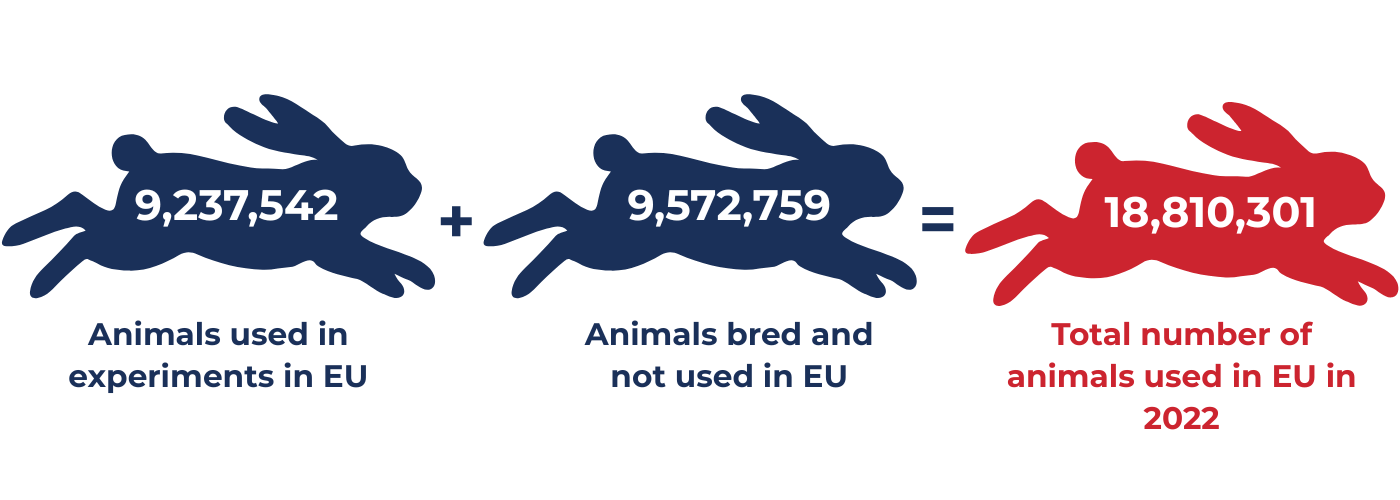
The latest figures, released in 2022, reveal that a staggering 9,572,759 animals were bred and not used across the EU’s 27 countries, plus Norway. That’s actually more animals than were used in procedures.
In that year, 9,237,542 animals were used in EU scientific procedures. This means that, overall, 18,810,301 animals were used in science in the EU in 2022.
This shows why it’s so important that Britain starts publishing these figures, too – because the total number of animals used in science overall in the EU is more than double the number of animals used in scientific procedures.
Just some of the Forgotten Lives who were bred and not used in the EU in 2022 include:
7,686,858 mice
6,070 hamsters
388 reptiles
304 dogs
211 equids
44 baboons
as well as many, many others.
Why are animals being bred and not used?
The main reasons why animals are being bred and not used are:
They’re parent animals who are used to breed animals for experiments.
They’re used to provide tissue samples.
They were bred and are the ‘incorrect’ sex for the study.
They are ‘surplus’ to requirements because they were bred to ensure ‘sufficient’ numbers were available but were not needed in the end.
They died before they were going to be used for a procedure.
What needs to change?
If the UK is ever to reduce and ultimately replace animal testing, it’s imperative to know exactly how, why and in what numbers animals are being used for science.
Following its commitment to record and publish the number of animals who are bred and not used in scientific procedures, the government now needs to ensure these animals are also included in their strategy to phase-out ALL animals used in science.