
Sharing expertise from around the world
Experts from across the globe have come together to help us highlight the links between animal cruelty and human violence.
Due to our level of expertise, particularly around public protection, we are often asked to present and give training around the world.
Over the past two years, we have presented to judges in Greece, police officers and judges in Kosovo, Athens and Thessaloniki, animal groups in Estonia and at Stormont in Northern Ireland.
We have more projects planned for 2026.
During 2024, we have seen change, and in May 2024 it was very positive to see the European Parliament recognise the animal – human abuse link for member states within domestic abuse legislation. We first presented on this to them in 2022.
As well as taking this campaign to Westminster we spoke at Stormont in Belfast, presented to Supreme Court Judges in Athens, judges and police officers in Kosovo, animal groups in Estonia, connected to TV audiences in Moldova and regularly featured across mainstream media in the UK.
We have also taken part in events either in person or online in Canada, USA, Australia, India, Moldova, Italy and now Greece.
On World Animal Day we took part in a groundbreaking collaborative training webinar alongside police contacts in the USA, France, Belgium and Switzerland.
Explore this section
Navigation to go here
Campaign updates:

We sought to embed the animal–human abuse link into frontline practices

In 2023, the 44 websites run by police forces across England and Wales didn’t offer any advice to survivors of domestic abuse where pets had been harmed or threatened.
We wanted to make sure we made everyone aware of the harm that can be done to survivors of abuse when their pet is targeted.
We want to ensure that our campaign message is heard globally. In 2022, we presented to a subcommittee of the European Parliament about animals within domestic abuse.
We want to advance animal welfare in as many countries as possible and deliver awareness training as widely as possible on the need to take crimes against animals seriously.
We want to reach MPs to explain why animal welfare matters.
We sent Freedom of Information requests to every police force in England and Wales, and over 650 supporters emailed their MP calling for mandatory training on the role of pets within domestic abuse.
Ensure animals are properly included within all 270 Multi Agency Risk Assessment Conferences across England and Wales.
Advocate for Holly’s Law, including an animal abusers register, to improve access to information about those who harm animals.
Develop a joined‑up action plan that protects animals and safeguards people, aligned with government strategy.
Our work around the globe
Discover where we’re helping to build safer communities with our training.

Presenting at the Zero Stray Pawject in Athens
Zero Stray Pawject trains police officers and prosecutors across Greece.
Our Campaign Manager has worked alongside animal groups and police officers in Greece since 2015, and in October 2025, we were honoured to take part as expert presenters during four days of intensive police training in Athens and Thessaloniki, organised by the Zero Stray Academy in close collaboration with the Chief of the Hellenic Police and the Minister of Citizen Protection. You can read more about this year’s training here.
This important event brought together police officers, prosecutors and animal welfare professionals including vets to strengthen understanding of the link between animal cruelty and community safety. This message is central to our campaign.
As a result of these sessions, police officers across Greece will receive more training on how to recognise and respond to animal cruelty, understanding how such crimes are often connected to wider social issues, including domestic abuse.
Did you know
- Greece now has the toughest maximum jail sentence for animal abusers anywhere in Europe – 10 years for felony cruelty such as torture or killing.
- In 2023, over €8 million in fines were issued under new animal welfare laws, showing clear progress in enforcement.
- Animal welfare in Greece sits uniquely under the Minister of Citizen Protection, allowing the police to play an active role in preventing cruelty and protecting both animals and people.
- There is now a dedicated number to report animal abuse – Greek citizens and tourists can call 10410 to report any incident of cruelty, neglect, or killing of a stray or domestic animal. Reports go directly to the Hellenic Police Headquarters, who alert local police to investigate immediately.
- These latest police training sessions build on an online learning programme we helped develop, which has already reached over 1,560 officers
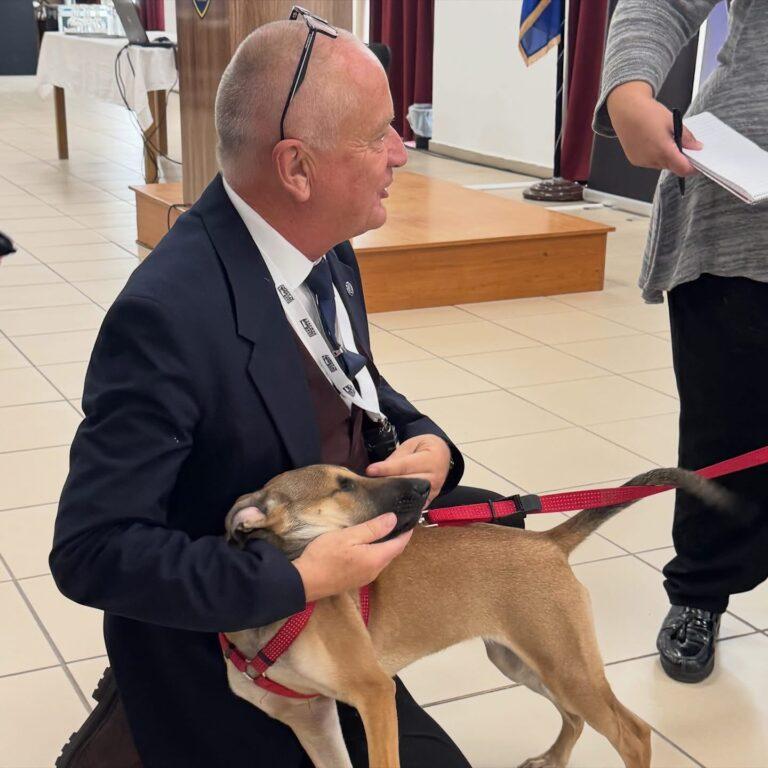
Ten years ago, our Campaign Manager delivered his first presentation to senior Hellenic Police officers in Athens on the connection between wildlife trafficking and terrorism. A decade later, it’s inspiring to see how far Greece has come.
Due to campaigning by the Animal Rights Foundation, neighbouring Kosovo has now developed similar animal protection legislation, increased maximum jail terms for cruelty, and introduced a risk assessment tool within domestic abuse cases to identify when pets may be at risk . This system is already used in the UK and was introduced in Ukraine in 2019.
Campaigning in Kosovo
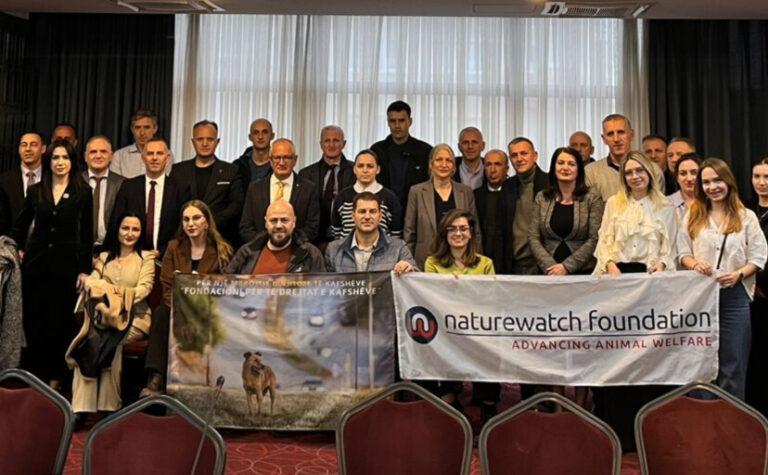
We took our campaign to Kosovo, where we met animal groups, judges, police officers and government veterinarians to provide training and to present our ‘Protect Animals. Protect People.’ campaign, to explain why taking animal welfare and abuse seriously can help create safer communities for people too.
Due to the campaigning of the Animal Rights Foundation, Kosovo has developed animal legislation and recently increased maximum jail terms for cruelty. They also have incorporated a proforma risk assessment into domestic abuse assessment that includes whether pets may be harmed as part of the abuse, in the same way, we do in the UK and that Ukraine introduced in 2019.
Domestic Abuse Awareness Month
October is Domestic Abuse Awareness Month and, of course, World Animal Day.
In 2025, our Protect Animals. Protect People. campaign travelled to Greece, highlighting the link between animal cruelty and domestic abuse through police training and helping officers understand how protecting animals contributes to safer communities.
Closer to home, we also co-hosted APDAWG, our UK event at Parliament, where legal experts, survivors, campaigners, and MPs came together to discuss protecting pets in domestic abuse. Across both events, we reinforced the message: when we protect animals, we protect people.
Our ground-breaking nine point plan
Naturewatch Foundation aims to lead the way with advancing animal welfare.
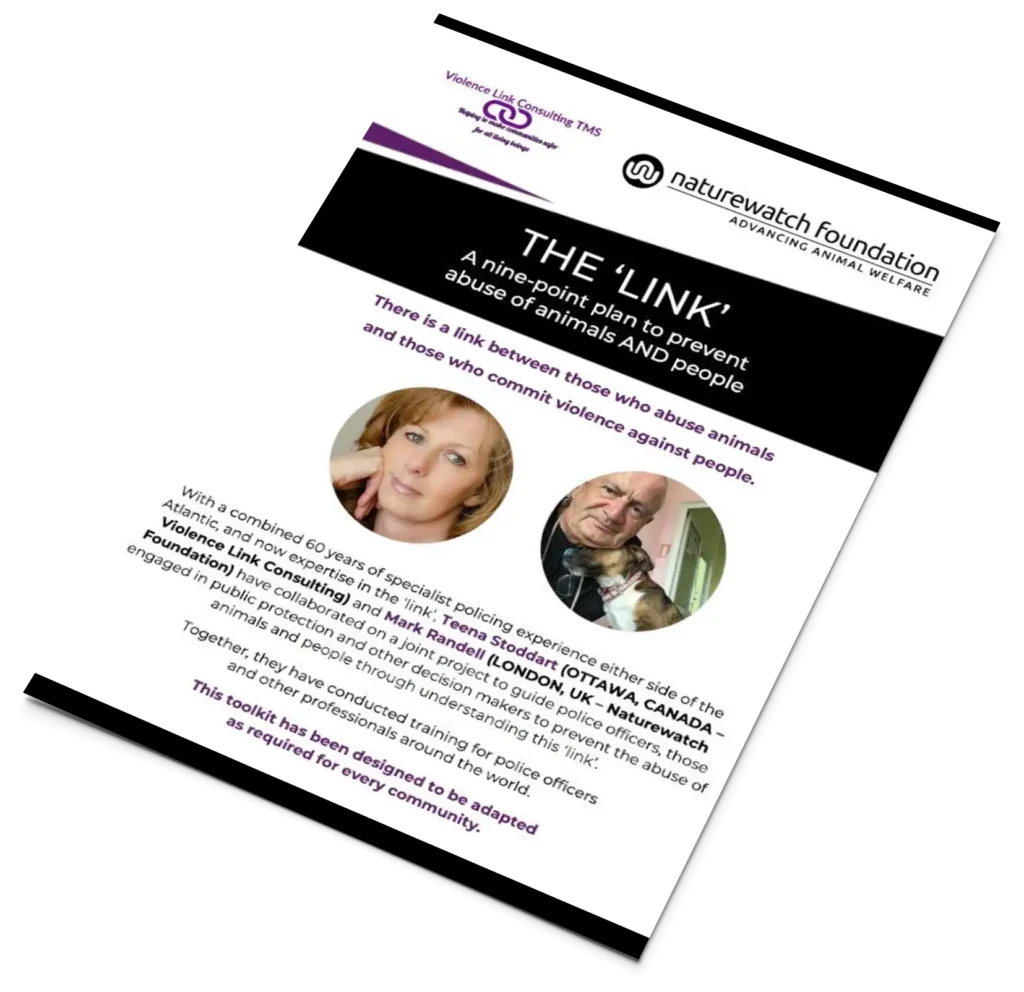
We have brought together 60 years of policing experience on both sides of the Atlantic to create a NINE POINT PLAN to give police officers and public protection officials around the world a guide to follow.
Our mission is to help make communities safer for animals AND people.
This is a groundbreaking, but generic, guide so each country can consider how these points may be adapted for their country and it is available here.
1
When an animal crime is reported to police it should be recorded, the Modus Operandi (MO) should be recorded, and the same investigative decision process should be considered, as with all violent crime.
The MO should be reviewed by someone who has received training on the ‘link’ and a referral should be made to a more experienced investigator if required.
An overview should be kept of all similar offences so that analysis can be carried out to establish any threat to people in the community.
2
When an officer attends an animal ‘crime scene’, they should consider what other violent crimes may be present, such as domestic, child or elder abuse and make appropriate referrals to specialist departments. (This will be established through officer observations at the scene, forensic work, witness interviews, or interrogations of the suspect/accused.)
Similarly, when an officer attends the scene of human violence, consideration should be given to the welfare of any animals present at the scene.
In the event of either animal abuse or human abuse, violence ‘link’ questions (based on evidence-based research) should be part of any interview relating to the occurrence.
3
Adequate facilities should be made available for anyone involved in a domestic violence situation to leave to a place of safety with their animals, or a place should be provided where pets can be housed until the human victim has a safe place to reside.
Keeping in mind that pets can be farm animals, the housing of animals option must include those that will accept any species.
4
Criminal laws (or judicial/sentencing advice linked to the law) should formally recognise how abusers can use animals as part of coercive control in family/domestic relationships.
Given the instances where a pet is not harmed, but threatened, the court brief should be required to disclose if the human victim was coerced, controlled, or intimidated by threat or violence to a pet, and appropriate charges should be laid.
5
Those who abuse animals sexually should be referred to persons qualified to investigate human sexual abuse, and those specialists should receive training in the ‘link’.
Consideration should be given to the welfare of the abused children and the animals involved.
6
Detectives engaged in investigating online child protection crimes must be trained in the ‘link’ between animal and human violence.
When animal pornography is revealed, an investigation should take place into whether that online identity is also involved in child pornography.
In countries where there is an appropriate charge for animal pornography, it must be laid.
7
Those that abuse animals intentionally, or recklessly, should be referred to police officers trained in understanding dangerous offender behaviour, and these officers should receive training in the ‘link’.
8
Police officers/detectives investigating a ‘link’ case should contact local animal welfare investigators to acquire information regarding whether the suspect has been involved in animal abuse cases previously.
This should be disclosed in the court brief.
Many countries do not have databases that include animal abuse charges and violence ‘link’ cases. Police would never know if an animal abuse investigator laid a charge.
9
Police and animal welfare investigators should receive training in animal fighting. When a case of animal fighting is uncovered, area animal welfare investigators and police should work together.


