A happy ending for one beagle who survived a beagle testing laboratory
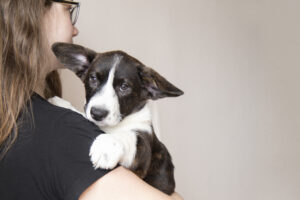
In September, we met Leia, a beautiful beagle who is absolutely adored by her human, Lucy. However, Leia didn’t have the start in life that most of our doggy companions do. She spent her first six years in an animal testing facility in Ireland. Thankfully, circumstances meant she made it out and was rehomed. Something that sadly doesn’t happen for most dogs in labs.
Here’s what Lucy told us about Leia when we met.
Can you tell me a bit about Leia?
Leia is around 11 years old and we adopted her in 2017. Her favourite thing in the world is steamed broccoli! She thinks it’s better than any other treat. She lives with our three other rescue dogs. She’s far more of a lap dog than a typical beagle; she is happier at home on the sofa than going out for a walk. She doesn’t play that much – she wants to but doesn’t really know what to do.
What’s her back story?
Leia came from a testing facility in Ireland. She was there for about six years before it closed down and the animals were relinquished to rescues. There were around 300 dogs, 200 cats and some small animal species that came from there. I didn’t want to look too much into what they tested at the lab she came from, but I know it was some sort of pharmaceutical testing.
She wasn’t overly well looked after. When she arrived at the rescue, she hadn’t seen grass before or seen a food bowl. She had never been outside. She’d never see any people other than those who worked there. When we first got her she would howl from between 3 – 4pm every day and it took ages for her to stop that. I think it was a habit she picked up. She had to have around thirteen teeth removed because they hadn’t taken care of her dental health; she only has a few teeth left now.
What was Leia like when she first came home?

When she first came home, I was with Leia 24/7. We had a crate set up in a back room in the corner and she stayed in there for a few days. She eventually made it into the living room but sort of stayed in the corner. And then after another few days she just about got up on the sofa.
It took her about two months to be comfortable at home. She was still afraid of everything, but less scared all of the time. When she would get very scared she would freeze, but she stopped that eventually. We thought she was deaf for a while and we had her checked at the vets, but it turned out she had no concept of being called. She just thought it was background noise. It took her a long time to learn her name.
All rescue dogs take a little while to adjust to a new home, but do you think you had to provide Leia with additional support?
Out of the four rescues we have, she was the most traumatised. When she came home she had to be carried through door frames because she was too scared. We took things really slowly and gave her a lot of space. She didn’t like to be handled when we first got her, so we tried to be hands off so she could work out we weren’t going to hurt her or grab her.
Eventually when she learnt we were okay we did a lot of work on desensitisation, particularly on walks. She doesn’t like white vans at all, so if we’re out and she sees a van it’s a big deal for her. So in the early days, we had to take things really slowly and let her work out for herself that everything is fine because, unfortunately, we can’t tell her that.
Has Leia got over her past or are there ways she’s still affected by it?
She’s much more confident than she used to be because she hadn’t experienced much before. She still has some residual PTSD. When she’s at home and there is nothing to be stressed over she’s a relatively ‘normal’ dog. But if there’s a loud noise outside or if she goes somewhere new, she can be scared by a lot of things. If she looks out of the window and a white van goes past, she can be very unsure about that. On the whole, she is much better, but she hasn’t forgotten all of the scary things that happened to her.
How has Leia influenced you and your life?
She’s my baby. At home, she’s my dog. I got her when I had ankle surgery so I couldn’t walk much when she first came home, so on walks neither of us could walk very far! So we slowly introduced everything to her. She has increased my personal interest in animal welfare. I’ve always been interested in it but she’s increased my day to day thinking.
I only buy things that haven’t been tested on animals because I’ve seen how affected she has been, so I don’t want to support that in any way and I’m more active myself in not supporting that. I follow a lot of causes and I get involved in helping with activism where I can.
If you could give a message to the government about the ongoing use of dogs in animal testing, what would it be?
I think the overall message would be we have to stop using them. It is a complicated issue and I’m aware that the entire eradication of animal testing probably won’t happen for a very long time. But I think there’s a lot of instances where animal use is probably not necessary anymore. So the least they can do is reduce it.
There’s a lot of brands that don’t test on animals, for instance, and the scientific advances we are making are making it more obsolete. I think the big picture goal has to be eradication, but as a starting point it needs to be stopped where it’s proven to be unnecessary. As a minimum we have to improve oversight and standards of labs and the breeding facilities. That’s the least we can do.

What are animal experiments?

What we’re doing

Your support
Whether you’ve got an hour or 60 seconds, you can help to end unnecessary deaths and suffering. Our Compassionate Shopping Guide is a great way to buy with peace of mind – you can even ask your favourite brands to get on board.